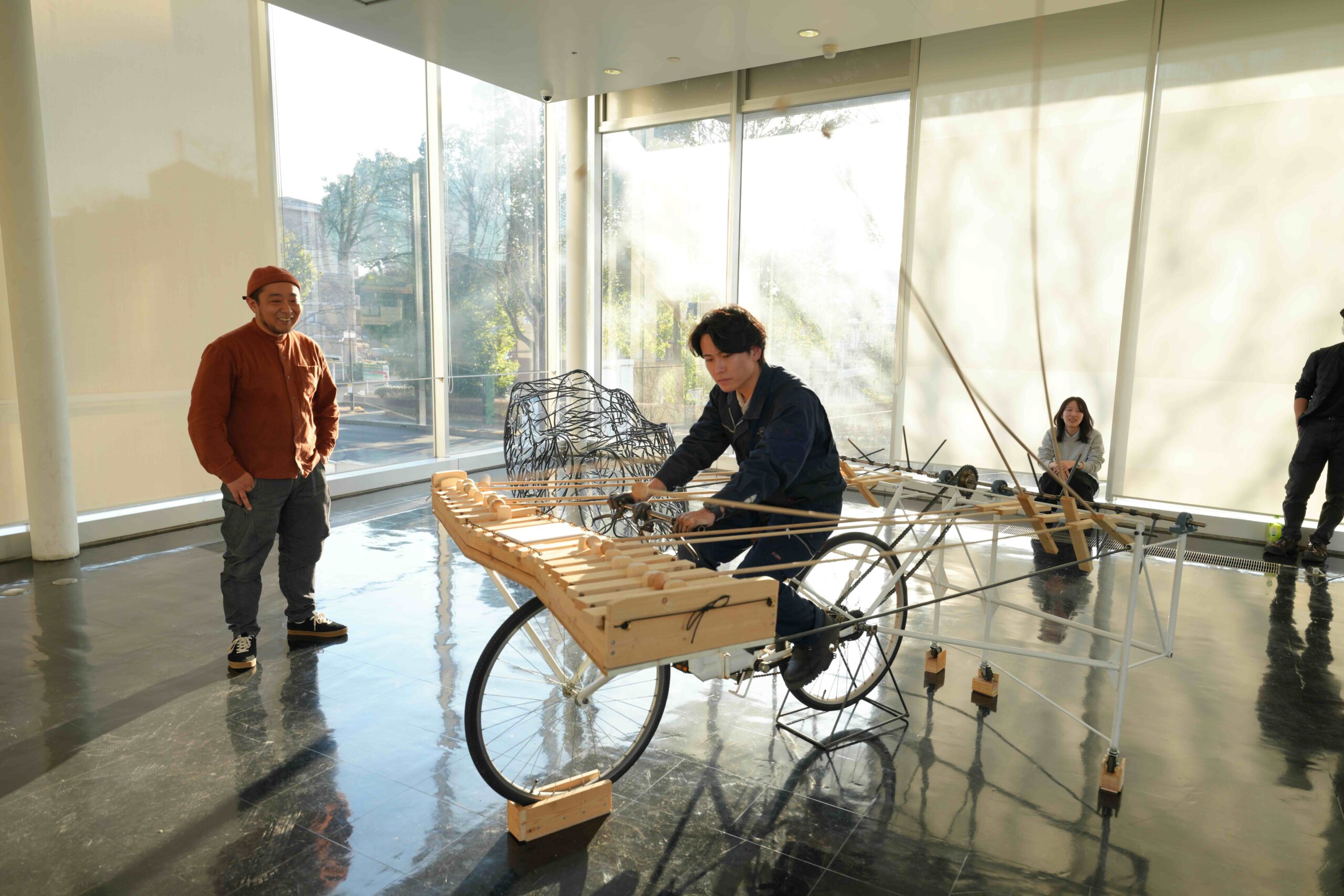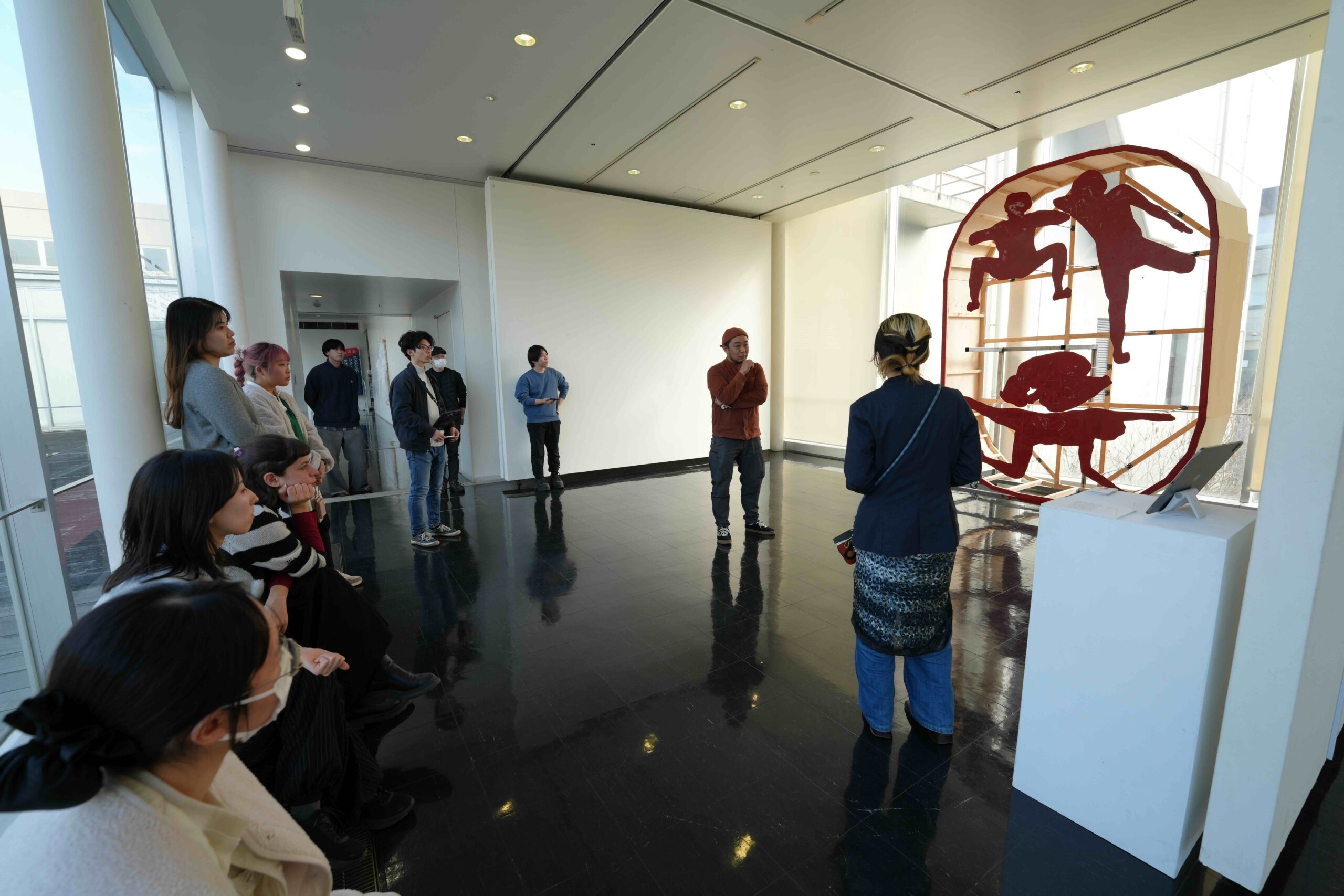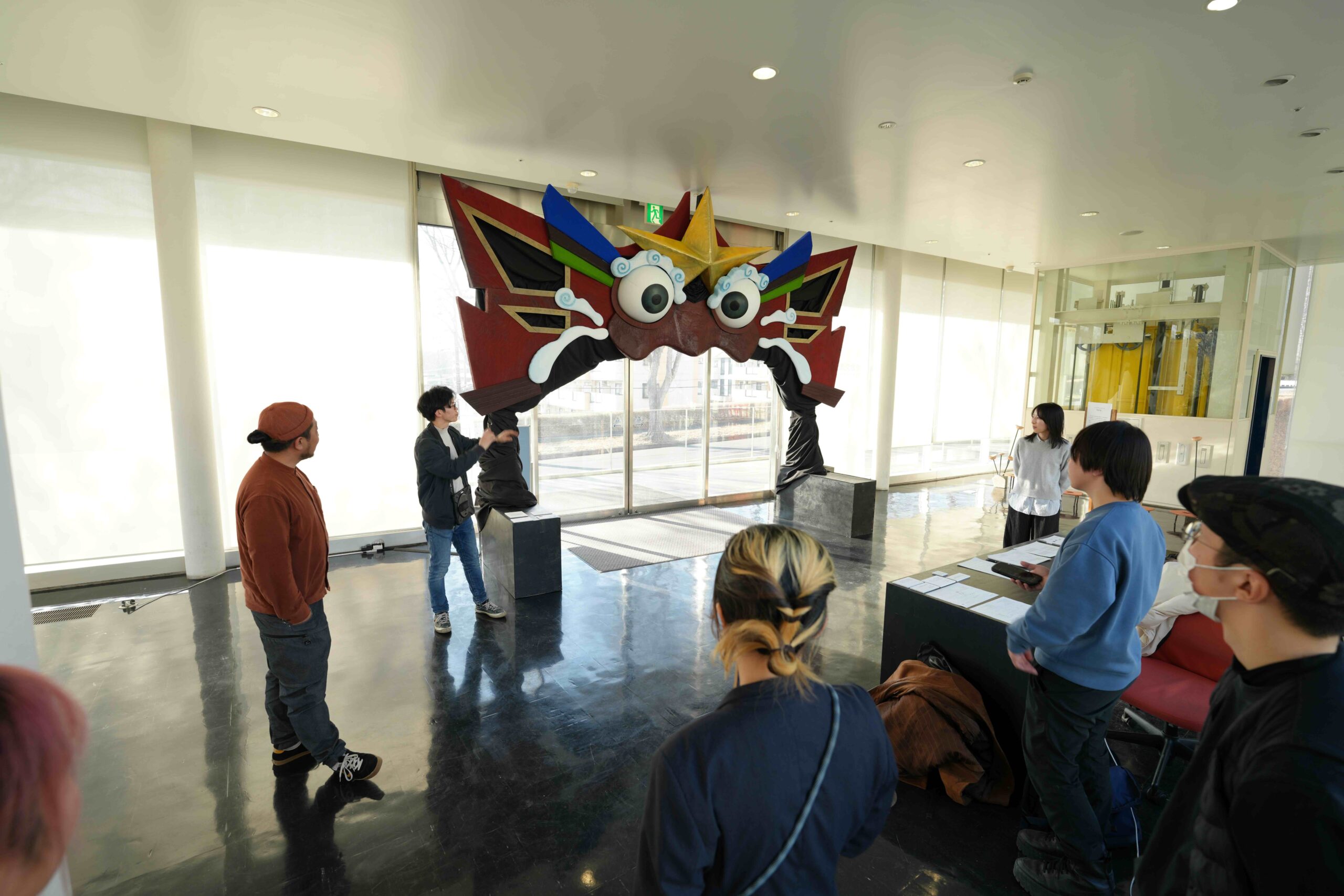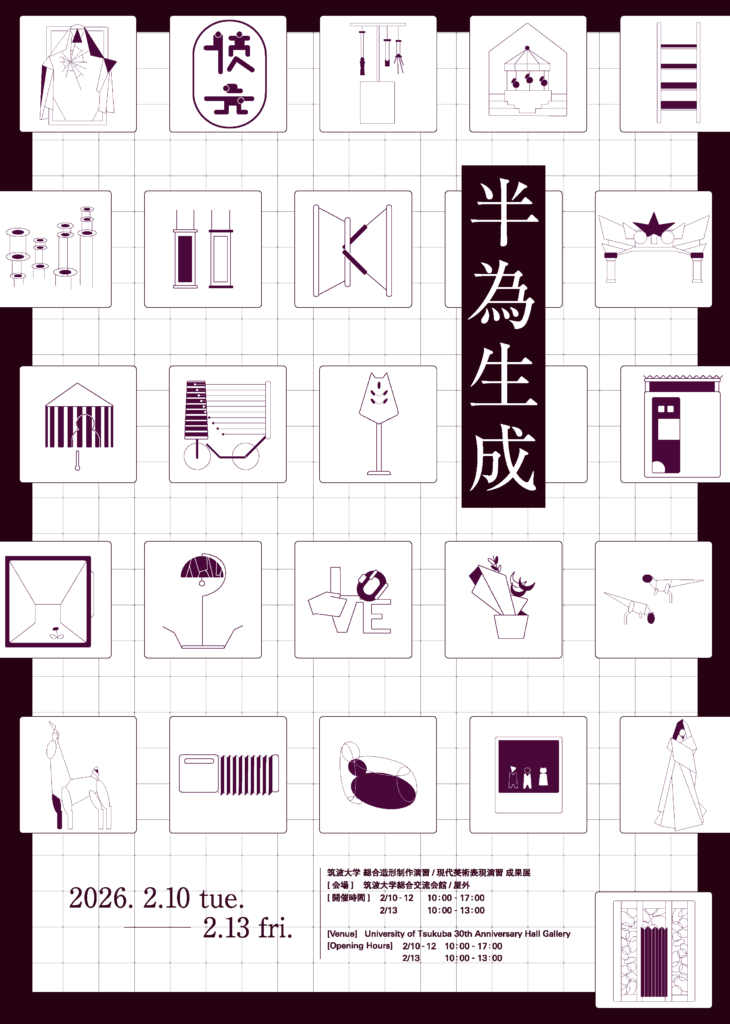
From February 10 to 13, 2026, the exhibition Han’i Seisei was held at the University of Tsukuba Kaikan and other locations across campus. The exhibition presented the outcomes of students enrolled in Integrated Plastic Arts Studio I & II and Contemporary Art Practice, courses taught by Assistant Professor Koichiro Azuma of the Faculty of Art and Design.
The exhibition title, Han’i Seisei, was inspired in part by Koichiro Kokubun’s The World of the Middle Voice. At the center of the exhibition was the concept of the “middle voice,” which points to a mode of action that cannot be fully understood through the binary opposition of “doing” and “being done to.” Based on this idea, the exhibition sought to reconsider artistic production not as something fully controlled by the maker, nor as something wholly surrendered to external forces, but rather as a process of becoming that emerges in between. On view were works shaped through the complex interplay of many elements, including materials, collaboration with others, and the conditions of the exhibition site itself. These works could be understood as having been “partly made and partly generated,” often exceeding the artist’s original intention. Visitors encountered not only finished forms, but also multilayered and diverse expressions that included the production process and the works’ relationships with their surrounding environment.
As a special program during the exhibition period, Junya Kataoka, a graduate of the university’s Integrated Plastic Arts program and a contemporary artist active both in Japan and internationally, was invited as a guest critic. Kataoka engaged seriously with each student’s work and offered comments that were both incisive and generous, grounded in professional knowledge and experience. Through this dialogue with an artist working at the forefront of contemporary practice, students were given a valuable opportunity to re-examine their own expression from a more objective perspective and to rediscover the moments of “generation” within their creative process.
Over the course of the four-day exhibition, many visitors engaged with the results of the students’ explorations. The exhibition served as a meaningful conclusion, inviting viewers to rediscover the richness of artistic practice as something not produced by the artist alone, but born through relationships with a wide range of materials, people, and circumstances.